|
 |
 |
|||||||
 |
 |
 |
 |
 |
|||||
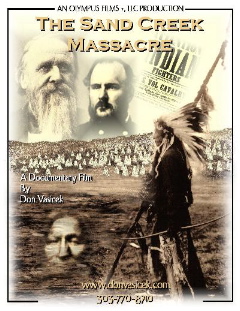
Film tells Sand Creek story from tribes’ eyes Don Vasicek’s dream is to document a nightmare of many American Indians. The Centennial filmmaker and writer has worked for the past four years, using his money, to create a documentary on the Sand Creek Massacre. All that work has yielded a 61⁄2-minute demo of the documentary, which will be shown Friday in Castle Rock.He’s found support difficult to come by, as Vasicek freely admits the film’s point of view rests squarely with the Cheyenne and Arapaho Indians. “This happened 140 years ago,” Vasicek said. “Nevertheless, they carry the grief with them today.” The grief comes from the event’s particularly brutal history. On Nov. 29, 1864, soldiers from Colorado’s 1st and 3rd Regiments, under the command of Col. John Chivington, attacked a group of Cheyenne and Arapaho at Sand Creek, about 145 miles east of Colorado Springs and 35 miles north of Lamar. “The attack at Sand Creek resulted in the deaths of over 150 Indians, the vast majority being women, children and infants,” according to the National Park Service’s Web site for the Sand Creek historic site. “For the soldiers, losses were much less, with about nine or 10 killed and three dozen wounded.” The film portrays tribal elders relating “oral histories of what their descendants experienced at Sand Creek,” Vasicek said. After filming in Oklahoma this summer, Vasicek said he formed an emotional bond with the Indians. “I just saw how significant, vital and important this is to the Cheyenne and Arapaho people,” he said. “It’s vital for someone to do something to record those histories.” Several companies are interested in seeing Vasicek finish the film, he said, including Rocky Mountain PBS and The National Museum of the American Indian-Smithsonian Institution. Cinema Guild International has urged Vasicek to complete a 20-minute version for classroom showings. “It’s time for the Cheyenne-Arapaho people
to tell their truth,” he said. “And hopefully it can be educational
for young people to learn something about problem-solving in a nonviolent
way.” Thoughts from the Producer, Donald L. Vasicek When I walk at Sand Creek today, I step carefully. My size ten and a halves sink into the sand. Where there is grass or plants, Canadian thistle or tamarisk or sage or some other one of the numerous types of grass and plants at Sand Creek, it catches my clod hoppers, just before they sink into the sand. Stepping beside the gnarled and stately cottonwood trees, roots feel hard under my Reeboks. The roots catch my feet, perhaps, like guardian angels, but yet, possibly parts of human remains. I know not where to take the next step, or how. I fear that I will step on someone who died here, whose remains are permanent parts of the sand, the grass, and the trees. I wonder if I am walking in the buffalo wallow where this woman died. I step carefully because I feel the people who died here reaching out for me and I can't see or hear them. I don't know how to help them. I feel their presence, their fear, their terror, their disbelief, their helplessness to save their children, their husbands and wives, their disabled relatives, their parents and their grandparents. Just like when I sat on a curb at Ground Zero in Manhattan two weeks after 9/11, I grieve for them. I grieve for myself. I grieve because I am alive and they are deceased. I grieve because I am helpless to give something to these victims to neutralize their agony, perhaps even, to reverse their deaths. I turn and scan the horizon. It appears like it is overlooking the Sand Creek Massacre Site. Somehow, it makes me feel better, at the least, for the moment. Then, I have to move forward. I look down and wonder, where should I place my foot next? ~Donald L. Vasicek, Writer/Filmmaker, Olympus Films+, LLC The Sand Creek Massacre Documentary Film Project consists of eight parts: 1. Award-winning trailer (1:45) (completed) The target audience are schools, colleges, universities, libraries, museums, television, cable
|
|||||||||
|
|
|||||||||
Click the Poster for More Details |
|||||||||
The Sand Creek Massacre Witness Account, One Story of Horror At Sand Creek Duncan Kerr, the scout, found the body of One Eye lying near the camp. "Some of the boys had scalped him, " Kerr wrote, "but they either did not understand how to take a scalp, or their knives were very dull, for they had commenced to take the scalp off at the top of the head, and torn a strip down to the middle of the neck." A short distance beyond, he found One Eye's wife sitting alone in a buffalo wallow: "I went up to her and laid my hand on her head. She looked up quietly, and recognizing me said; 'How de do Dunk, me heap dry. Gib me some water.' I asked in the Cheyenne language, if she was seriously hurt. She replied by throwing the blanket back and showing me aghastly wound in her side, through which the entrails were protruding. The wound must have been caused by a fragment of a shell. I gave her a drink of water, and left my canteen. As I turned to leave, she took my hand to detain me, and begged me to shoot her with my gun....But I could not do it, for I had known her a long time; a lively, sprightly, mischievous, little thing, that fairly worshipped her Chief One Eye. This is the squaw that One Eye brought into Ft. Lyon with him and was on our trip after the captives. When she saw I would not kill her she covered up her head and began singing her death song again....I had not gone very far, when I met a soldier. I pointed her out to him, and told him I had just shot and wounded an Indian and had fired my last shot; that the Indian was badly wounded, and could not help himself, and I wanted him to creep up behind the Indian and shoot him in the back of the head. The fellow crept up close behind her and shot her dead.... -"Sand Creek: Tragedy and Symbol Pt. 1" G. L. Roberts, 1984 |
|||||||||
|
|||||||||
 |
|||||||||
|
Home | About | Services | Awards | Blog | Projects | Contact |
|||||||||
 |
|
|
|
|
|
|
|
|
|